Showing posts with label Nicholas. Show all posts

Monday, September 26, 2016

Whoops I Did it Again

Things have been absolutely insane around our household and I have been terribly terribly remiss in updating. I apologize and promise that it's been mostly good news that kept me away!

In mid-August, I started my new job. While it's a big change from what I'm used to, it's really a fantastic company to work for and it's great to feel challenged to learn something new. With the new job came many new things for our family - for the first time the twins are in daycare. We found a school that specializes in special needs children but also accepts "typical" children, and luckily they had space for both Emily and Nicholas! We've seen leaps and bounds of development from Emily who is now trying very hard to talk. She's doing very well, and is even attempting sentences now! Nicholas is trying to emulate the older kids (they are in a classroom for 18 months to 3 years old and are the youngest of the group), and we've noticed him verbalizing a significant amount also, along with working on ways to get from point A to point B more efficiently and voluntarily going to a standing position.

Also with the change, Mike was able to move back to a day shift at work which has been amazing for our family. We can actually eat dinner together most evenings (he still works news - breaking stories still happen), he gets to be more involved in Zachary's taekwondo, and we actually feel like a family again.

Things have been pretty quiet here, albeit incredibly busy with life, but nothing out of the ordinary until recently. We had noticed that Nicholas's g-tube was leaking a little. We mentioned it to his pediatrician at his 18 month check up and they told us that the button may be sized a tad small since they've never resized since he had his g-tube placed at 3 weeks old, but that we would keep an eye on it. A brief lesson in g-tube sizing: Nicholas was wearing a 14 french 0.8. That means the part of the tube that actually goes through his abdominal wall into his stomach was 14 french (a form of measurement) around and 0.8 mm long. We noticed the leaking getting worse, so we went ahead and changed the tube. It continued to get worse until almost every feed, he would leak so significantly that his entire shirt would be soaked and smell of stomach acid.

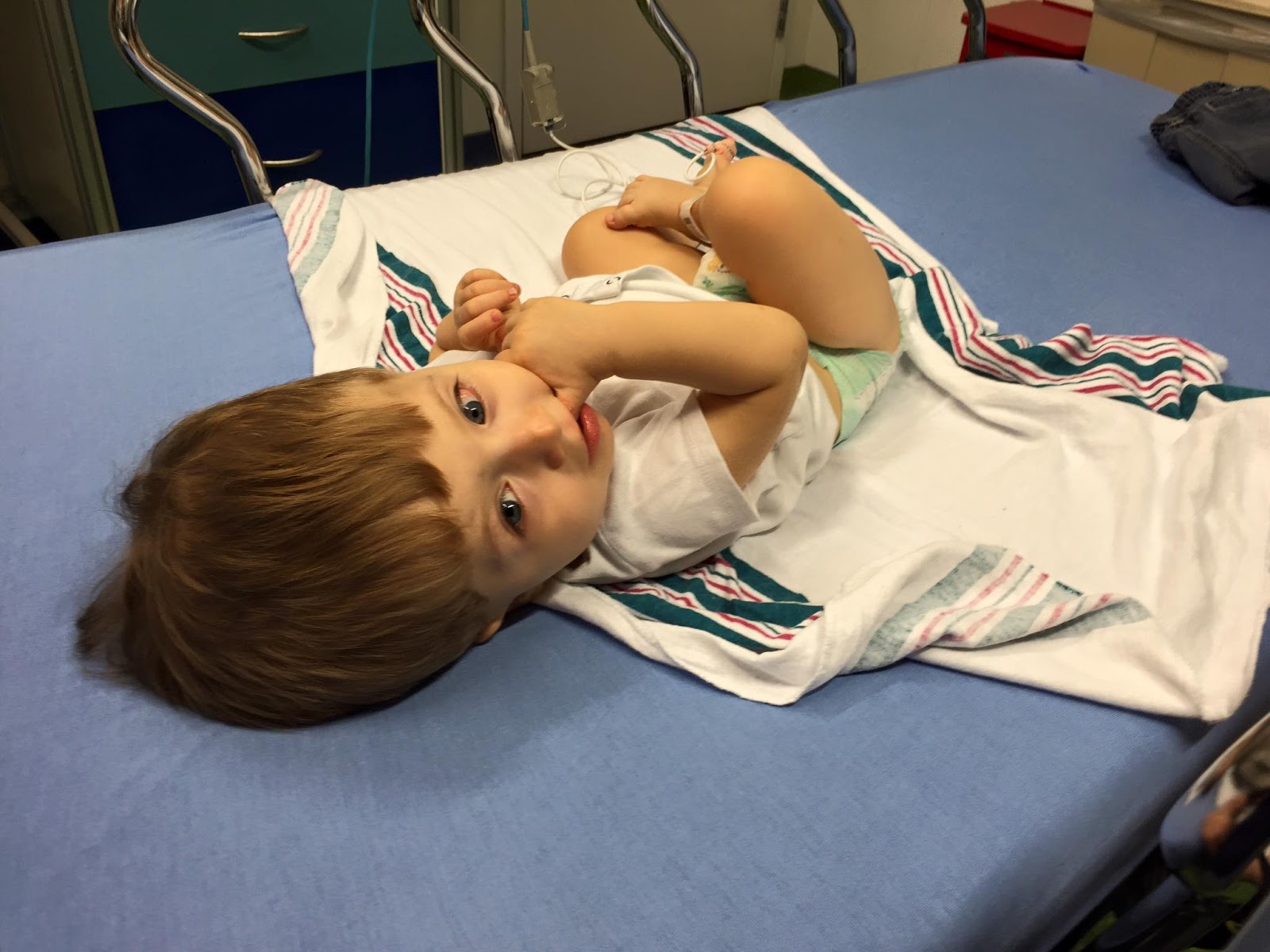
On a Sunday morning, we noticed that his belly around his g-tube site was red and raw. He was screaming in pain every time we fed him. We called the on-call pediatrician who told us that the children's hospital emergency physicians are all trained on g-tube resizing so we should take him to the emergency room to have it looked at. He also mentioned that if we didn't feel comfortable with the emergency room physicians resizing the button, the general surgeon who placed Nicholas's tube originally was actually on call and in the hospital that day. Mike whisked off to the emergency room for what we figured would be an easy fix. After several hours (things do not move quickly in hospitals), they were home. Nicholas had a freshly placed 14 french 1.2 button. He was past due for a feed, so we set him up and started the feed. Nicholas immediately began screaming in pain and the hole where the g-tube button is began leaking so badly that we were actually unsure if any of the feed was even making it into his stomach. Mike packed Nicholas up and took him back to the ER. The surgical resident came down and looked at his g-tube. He decided that Nicholas appeared to be between sizes - he thought a 14 french 1.0 would be too small but a 14 french 1.2 was just slightly too big. Unfortunately, there is no such thing as a 14 french 1.1. He left the decision up to us, but suggested we stay with the 1.2 because scar tissue would form and until then, we could pack the site with gauze to kind of build up the distance and hopefully stem the leaking. He was wary of switching the tube again simply because Nicholas was already in so much pain that he didn't want to add to it.

We took his suggestion and called the surgeon's office for a follow up visit. We were able to sneak into an appointment on Wednesday and the surgeon ended up changing the tube at that visit back down to a 14 french 1.0. At that time, Nicholas was diagnosed with a chemical burn from the stomach acid leaking out of the g-tube site. He was prescribed a topical ointment and we were told to attempt to let the site air dry as much as possible.

By Friday afternoon, we thought things were getting better. As I sat in the chairs at Zach's taekwondo class, Nicholas became very agitated. I was holding him, trying to calm him down, and I realized his onesie was soaked through again. I took him to the bathroom to try and get some cool water on his belly until we could get home and I could change him and fix the dressings and that's when I realized that blood was pouring out of his g-tube site from beneath the button. I asked the director of the school if Zach could stay there (he had demo team practice later that evening) until Mike could get off work and meet him there, grabbed Emily and Nicholas and headed to the hospital. Zach was treated very well while I was off - hanging out with his favorite instructors and fed delicious food from a mom of his friend who graciously took it upon herself to run to Publix and pick up some food for him.

The ER doctors consulted in the surgical team again who decided they would like to see an X-ray just to make sure that at some point during all the button changes over the past week that his stomach hadn't disconnected from the abdominal wall and that we had just been feeding his abdominal cavity for a week. This can happen early in the g-tube placement process as scar tissue hasn't formed to adhere the stomach to the abdominal wall yet, but is a highly unlikely possibility after having had the tube for almost 2 years, however, we agreed with the surgical team - better safe than sorry.


The X-ray found that there to be no problem with the placement of the tube and it was decided that the bleeding was from irritation of the chemical burn. I had made my way back to taekwondo to pick Zachary up from demo team practice (and brought Emily back with me), so Mike was sent home with wound care instructions. The tube is still leaking somewhat, thought it's not nearly as bad as it was during this time. We've gotten the worst of the chemical burn under control, though it's still healing. The best conclusion we can come to is that it was a combination of things - the initial tube too small, transferred into a tube that was two big and allowed for significant leakage over three days before it was switched back out. Beyond that, he's currently getting his molars, so he's had more spit to swallow and because molars really suck to get, he's been crying more frequently than he normally does. Crying causes him to bear down, and may be contributing to the leaking.

Hopefully this will eventually just be a blip on the radar pretty soon. I feel like we're getting close to the end, but it's been a frustrating process.


Wednesday, July 6, 2016

Eye See - on the other side

Because he had surgery first thing in the morning, Nicholas was not allowed to eat past midnight on Thursday night. I fed him his 9 p.m. feeding and watched him for a few minutes. I knew that this time tomorrow night, we'd be about 12 hours post-surgery. I wondered what that would look like.

We'd been told the risks - they were low and few, but there are always risks with surgery. The biggest risk was that the surgery wouldn't fully work and that the issue would be either over or under corrected.

To be honest, we still don't know if that has happened. We won't know for several weeks once the swelling has gone down completely and the eye has healed from the trauma of surgery if it's worked or not fully.

Friday morning, Mike and Nicholas left crazy early to get to the surgery center by 6:15 a.m. We had decided that it made more sense for Mike to go with Nicholas and me to stay home with Zach and Emily. I got pictures of Nicholas in pre-op, dressed in his tiny hospital gown and happily watching Disney Junior.

I got a call when he was taken back to surgery. I got a call when the doctor came out and said he was done, and I got pictures of a sleepy little man when Mike was allowed into recovery.


When he was discharged and they got home, I got sweet little cuddles from a groggy, red-eye child.


We put him down for a nap and he slept for some time.

Over the holiday weekend, he remained off and on groggy, probably the efforts of his little body to heal itself. But he was never grouchy. He remained the sweet little guy who thought everything his siblings did was hilarious. He continued to work on his modified army crawl to get to the toys that he wanted to see. And every time we turned around, it seemed, he put himself into a sitting position.


It was driving us crazy to know that he could do it but that none of us had seen it happen yet. We really just wanted to know how he was doing it.

Nicholas had his follow up with his ophthalmologist today. His eye is healing quite nicely, the redness has reduced significantly, the crusty yucks that were leaking out have slowed to almost nothing, and as far as we can tell, his eye is in a much better position than it was. He has another followup in 6 weeks and we will have better answers then.

And yesterday afternoon, I finally saw him put himself in a sitting position. He has decided recently that sitting seems cooler than laying down and continues to sit up more and more frequently. He decided to show both Mike and his physical therapist the trick and today in therapy, with some help, he pulled himself to a standing position against the couch and stood very confidently for some time.

Monday, June 27, 2016

Checking Off Milestones

In all of his recent evaluations, Nicholas has been determined to be about eight months behind in his physical development. He's maintained a steady eight months behind in development level, which is great because it means, while he's behind his "peers", he is staying on his own track and isn't falling behind.

He is a few months behind in cognitive development, and is actually age appropriate, or even advanced, in social skills (which anyone who knows him will tell you - our giant flirt).

So, even though he's currently eighteen months old, he's technically considered seventeen months old developmentally since he was born a month early, and he's measuring at nine to ten months in his motor skills development level.

As I've mentioned before, Nicholas isn't crawling or walking yet, and we honestly don't know when that will happen. We're fairly confident that it will - he's proven himself to be a singularly determined individual, but it will be late. Many people with hydrocephalus, especially at the severity that Nicholas had, will never walk, so we're grateful that he likely will, even if late.

He's been sitting up on his own for some time now, as long as someone helps him into a seated position. His core strength has grown that he now sits for the entirety of a taekwondo class (while playing with the other babies), and it doesn't exhaust him. Early Saturday morning, I was up with all three kids. Zachary was watching cartoons, Emily was playing, and Nicholas was practicing getting into his crawl position. Suddenly Zachary says, "Mom! Look at Nicholas!" I looked over and Nicholas was sitting up next to the entertainment center, trying to get the DVD player. I said, "Oh wow, that was nice of you to sit him up, Zach!" Zachary said, "Mom, I didn't!" I asked him if he was being honest, did he really not help Nicholas at all? Zachary swore that he hadn't helped Nicholas up. Which left the conclusion that Nicholas had gotten himself into a sitting position for the first time ever. We watched him throughout the morning and it never happened again.

Until nap. We went to get him after his nap and he was sitting up in the crib. We knew at that point that he had to have done it himself. That night when we went in to feed him his 9 p.m. feed, we found him sitting up in the crib instead of sleeping, laughing and incredibly proud of himself. Since then, we've found him in a sitting position several times, though we've never actually seen him put himself there.

This little guy continues to amaze us, and we are so proud to be able to watch this journey of his!

Thursday, June 23, 2016

Eye See

After several weeks of patching, Nicholas followed up with his ophthalmologist where we learned that his patching regiment had done next to nothing to correct his eye. His left eye was still turned in pretty severely and the ophthalmologist was concerned that if we waited much longer, the possibility that Nicholas could lose his vision was high. Basically, because the signals coming from his left eye did not match with the signals (images) from his right eye, it would be possible for his brain to turn off the left eye to reduce confusion. In that case, the left eye would stop working and he would be blind in that eye. So, the doctor wanted to schedule the surgery.

He wanted to wait to hear from Nicholas's neurosurgeon first, so that we could be certain that the pressure inside Nicholas's head was within normal ranges and that pressure changes weren't causing the issues with the eye, and luckily, we just happened to have the annual follow up/ CT scans/ shunt series scheduled. As I blogged about earlier, that went very well and Nicholas was labeled stable by his neurosurgeon office - unless something happens (everyone knock on wood!), they would see him in a year. With the all clear from neurosurgery, we contacted the surgery scheduler at the eye doctor and Nicholas's fourth surgery was scheduled.

Today was his pre-op appointment and he was deemed fit to move forward with the surgery. Again, we have lucked out by getting matched with one of the best physicians in his field in Orlando. The eye doctor works specifically with children with neurological issues and has been performing this operation for over 20 years.

This is quite a common procedure, and also a fairly easy one (compared to the brain surgery and g-tube placement/nissen surgery he's had previously), but of course, it's still surgery. The ophthalmologist will be making a small incision on either side of his left eye. On the inner part of his eye, where his eye turns in, the muscle will be detached and reattached further back. The muscle on the outer side of his eye will be either folded and stitched to increase tension (the preferred method) or will be shortened and reattached. This will hopefully cause the muscles to pull his eye back into the correct alignment. Many people we know have either had the surgery themselves or have children who have, typically with fairly good results. The surgery has approximately an 80% chance of correcting the alignment issue with no further issues. It's possible to over or under correct, in which case we would try patching again and if that doesn't work, he would need to have surgery again. We're not going to look that far into the future though - we're going to just look at next Friday. He's scheduled to arrive at the surgery center at 6:15 a.m. on Friday, July 1st. The surgery will take around an hour (unless - in true Nicholas fashion - something strange comes up), and he'll be home that night. Everything I've heard, it's likely to be one of the easiest surgeries he'll have.

Thoughts, prayers, good wishes, whatever floats your boat are always appreciated. Send a little thought towards Orlando next Friday morning!


Friday, May 20, 2016

Lessons

Awhile back, I posted about the fight that we'd had with the PA at Nicholas's neurosurgeon to get a prescription for a cranial band. And that we'd seen such success with it.

When Mike had had his appointment with the PA, he had been told that because of the severity of Nicholas's hydrocephalus, the best thing we could do for him as parents was to take him home and make him as comfortable as possible for however long he would have. We had already seen progress from him at that point and refused to believe that we had reached the end of the progress. While we weren't going to fight that fight with the neurosurgeon's PA, we didn't plan on not moving forward with the therapies that he was responding so well to.

Last week, Nicholas had his first follow up appointment at the neurosurgeon's office since that fight. And he was scheduled to see the PA that had originally denied us.

Mike brought Nicholas (and Emily!) to the appointment. When the PA walked into the office, Mike had Nicholas sitting up on the table - independently. The PA walked in and was shocked the Nicholas was sitting up on his own and mentioned it. Mike nodded and waited for the measurements to begin. Nicholas's asymmetry was at 4 mm. The PA re-measured and looked at Mike. He was in awe. He said, "It worked. It actually worked." He couldn't believe it.

During the course of the appointment, Mike found out that the PA had truly believed that Nicholas would be severely disabled and that we would likely not see much development out of him. As it turns out, the majority of the fluid from the ventricles was pooled in the front of his brain during gestation and had caused damage to the frontal lobes. The frontal lobes are primarily responsible for gross motor skills (such as sitting, crawling, walking), as well as the swallow function. It makes perfect sense, then, that Nicholas has difficulty swallowing without aspirating and also that he is delayed with his gross motor function. But he's catching up. He probably won't walk before he's 2, but he very well may crawl. He's sitting up, completely unassisted, for 30 minutes to an hour now, where previously we were lucky if he sat unassisted for more than 5 minutes.

The PA told Mike that he was wrong. And that he is amazed in the development he's seeing in Nicholas. That it is completely obvious that the brain is regenerating itself and that nobody can tell what Nicholas can or will achieve. He credited us for fighting back in every area that we could. For being Nicholas's advocate against even him (the PA). The PA ate some humble pie that day, and for future patients of his, I am eternally grateful that he had the self-awareness to realize he had misjudged and that he could learn from his mistake. I felt a tiny stab of retribution too, of course, but mostly I'm just glad that he could reflect on his analysis and realize that perhaps he doesn't have all the answers. For the rest of his career, he will think of the little boy who surprised him when talking to parents. The little boy who refuses to stop.


Friday, May 6, 2016

Being Kind

Recently, I was having an issue with my phone that required genius intervention. Anyone who has any kind of an Apple product understands the wait that will ensue to get genius intervention at an Apple store, but my phone literally did not work (touch screen was completely non-responsive) and since we don't have any other form of communication than our cell phones, it had to be fixed.

I got home from work, traded out the guard with Mike as he headed off to work, and went over to the mall. When I got there I was told the next available appointment was in two and a half hours, so I took it and then decided the kids and I could go get some dinner.

As I've mentioned before in this blog, we tend to attract attention when we go places. People see the double stroller and are drawn to it. "Twins?" is the first word I hear out of almost everyone's mouths. And now that they're older and more interactive, people have even more fun with them. Nicholas, in particular, draws attention because he is so friendly. He loves to have attention - he will giggle and smile and try to touch you. He adores people.

On this day, I was a little out of sorts because I was stressed about the phone, and it's not easy to navigate a mall with a double stroller (one of whom really hates being strapped in now that she can walk) and a curious pre-schooler. Zach suddenly decided he had to go potty NOW. Luckily I had already made my appointment at Apple, so we walked as quickly as we could to the bathrooms and he declared that he would not go in there because it's for GIRLS. And of course, the family restroom was full. Both of the twins needed diaper changes too. I convinced Zach to come in and help me while I changed the diapers and then asked him to just TRY to go potty in the first stall nearest the diaper changing area. He asked me if that was for boys and I blurted out, "Yep, that's the one they save for boys who have to come in with their mommies!" He was delighted and ran right to the stall. I felt a pat on my back and I looked up to see an elderly woman smiling at me. "You're doing a fine job mama." she said softly, smiled at the twins, and then left the bathroom.

On this day, at this moment, as we headed out of the mall to go get some dinner while we waited for my Apple appointment, Nicholas was wearing his helmet, wearing his eye patch, and eating through his g-tube. All of this is normal to me. I am used to getting some glances, and even some curious kids asking, but it is something that people who know us really don't even pay attention to anymore. Zach had asked about going into a store and so I had stopped and was paying attention to him. I finished my conversation with him and looked up to a man standing in front of the stroller, gazing at Nicholas. The look on his face was one of pure disgust. He noticed me notice him and looked up at me.

"Is something wrong with him?" His voice was dripping with revulsion. It was like Nicholas was the worst thing his eyes had ever encountered. It caught me completely off guard.

I could have used the opportunity to educate him. I could have explained that yes, something is wrong, but he's okay. Instead, my mama bear took over and I growled, "Is something wrong with you?" He looked shocked, shot me a dirty look, and walked away. It hurt my heart with everything I had because I knew this wouldn't be the last time that he encountered something like that, and I lashed out. I don't know if he would have even listened if I tried to educate him, but I could have tried. My only saving grace was that Zach was distracted by the store he was trying to visit and I don't think he even realized the encounter happened, it was over that quickly, and that Nicholas had no idea what was going on.

Two very different encounters that left me feeling two very different ways. I wish that we all tried to build each other up. I wish that we all spoke with kindness and gentleness. I hope that I can teach my children to be the first encounter, not the second. And I hope that Nicholas can get through life without feeling the way that man made me feel, simply because he's different.


Friday, April 8, 2016

Let's get ready to army crawwwwwwllllll!!!!!

We have been noticing a significant jump in Nicholas's abilities recently. We've brought it up to his pediatrician, his therapists, and his helmet guy and are wondering if because of the fact that Nicholas is sitting up far more than he used to, the shunt is being assisted in removing the cerebral spinal fluid from his brain and there's more room for actual brain matter.


We also know that some pathways that were likely damaged because of the brain being squished in utero and during the first year of his life are beginning to regenerate. The human brain is amazing and baby brains are even more so. Even the NICU nurses and doctors told us that would happen - that pathways would likely regenerate.

So we are thinking that because of the combination of all these things, plus the addition of phenomenal therapists, Nicholas is having an explosion of development. He's been trying to roll over completely for ages now. He could roll over, but he wasn't great at it and he really hated being on his belly. I'm sure it was uncomfortable because he wasn't used to being in that position for the first year of his life. Plus, having the g-tube button may have hindered that somewhat too. He recently began sleeping on his belly and enjoying it. I put him down on his back and no matter how many times I've gone into his room to check on him and put him back on his back (wanted to make sure he wasn't stuck!), I'd go back in to find him on his belly again.


He's also started rolling himself around the room to get to places. Obviously this is pretty far behind developmentally, but it's something he couldn't do previously, so it's super exciting! He's become incredibly quick at getting places by rolling there. The other day, Mike and I went out on a date for his birthday (first "official" date night since the twins were born!). One of Zach's amazing taekwondo instructors babysat the kids for us (Zach planned a night of watching about 12 movies and eating popcorn). When we got home, the babysitter told us that Nicholas had been trying to sit up all night. We were floored. He had certainly never tried anything like that for us! She said, yep, he just kept trying. Because the kids were all up (babysitters let you stay up late and eat junk food - they're the BEST!), we were able to see Nicholas roll over to his belly, take his arms, and push up. It was nothing we'd ever seen him do before.

Most recently, I was home on a weekend day and was sitting on the floor playing with Zach. My phone was on the floor next to me and Nicholas realized it was there. He rolled over onto his belly and lifted up his head (getting stronger every single day) and then he started a slow but very determined army crawl towards my phone. I didn't believe it, so I called Mike into the room and moved the phone further away from him. He did it again. We've tried with toys, remotes, dog toys, a brother... but the only thing he currently seems motivated to army crawl for is a cell phone. So. Our cell phones have been hanging out on the floor recently a lot so that Nicholas can get more practice. His therapists were amazed when Mike showed them and Nicholas spent that entire therapy session army crawling for Mike's phone.

When I was pregnant with Nicholas, Mike and I were desperate for information about what hydrocephalus means to an individual. We were scared that we were setting Nicholas up for a difficult life. We needed to understand what we needed for him - how we would be able to help him, what help he would need, what the outcome would be for him. The high risk OB, the neurosurgeon that would ultimately become Nicholas's, my regular OB, even the pediatrician at Zach's office all told us there's nothing we can tell until he's here. The spectrum of how hydrocephalus affects an individual is so wide, and it can change throughout an individual's life, Now that Nicholas is here, I understand what that means. I've become entrenched in an incredibly supportive and strong hydrocephalus community since joining the HA to co-chair the WALK. Just among this small group there is a huge difference in how hydrocephalus has affected them or their loved ones. From a woman with over 200 brain surgeries to a teen aspiring to be a doctor, hydrocephalus has run the gamut.

So every day I remind myself what the NICU nurses told us - let Nicholas write his own story. Don't write it for him, just help him write it. And what an amazing story this warrior is writing.

Friday, March 18, 2016

Who's Counting?

During the first few years of a child's life, you spend a LOT of time visiting with their pediatrician. Even completely healthy babies get seen frequently for check-ups, vaccinations, and sick visits (even babies who stay home - have to build that immune system!). You become even closer to your pediatrician if your child has any kind of a medical issue whatsoever.

During each of these visits, as all parents can tell you, the baby is weighed and their length and head circumference is measured. These go on a chart as little dots and you have a brand new thing to stress about. Is my child's weight/height/head circumference normal? Is it too high? Too low? You leave the office in proud possession of their latest percentiles. Percentiles are rarely anything to be concerned about. If your child is in the third percentile, it just means that 97% of babies are bigger than him or her at this specific moment in time. It only becomes concerning when a baby doesn't follow their "curve." Emily, as I'm sure you can guess, tracks very low in her percentiles because she's a tiny little peanut. She is, however, on the full term growth charts as opposed to the preemie chart even though she was technically a preemie, so that's a tidbit to be excited about.

Nicholas tracks along his charts fairly well, with one exception. I'm sure you already know the exception is his head circumference. He was born with a head circumference of 46 cm. The "average" head circumference for a newborn is 36 cm, so you can see just how large his head was when he was born. He went as high as 47 cm while in the NICU, but some of that can be attributed to swelling after surgery along with human error (the nurses don't always place the tape measure in the exact same spot). Nicholas has always had a large head for his age and he's always been so far off the chart that it would be absurd to assign a percentile to his size. He's in the 175th percentile for age??? It's meaningless.

Obviously, unless the circumference shifted dramatically larger, his pediatrician was aware of his head circumference and was not overly concerned. The thought has always been that at some point, his body would catch up with his head and he'd start following along his growth curve.

Recently, he was seen for his 15 month (15 month????) check-up. He has recently made some significant leaps forward in his progress and we were excited to talk to his pediatrician about it. We've started adding real food to his formula diet. We're currently using fruit and vegetable purees and adding them to his formula and feeding it through his g-tube. We're still thinking that he'll eat by mouth one day (we don't know what day, but one day), and we'd like his body to be used to "real" food when it happens. His head size has also gotten smaller as I mentioned in a recent blog post. He's sitting up far more frequently and has started rolling over onto his belly and trying to push himself up into a crawling position.

While at the check-up, the standard measurements were completed. He's staying right on his growth curve for height and weight. And for the first time in his life, he is on the chart in head circumference. His body has finally started catching up with his head size. He's in the 97th percentile, true, but he's on the chart. It was really cool to finally see that dot fall in line with other babies his age. And it happened far sooner than we thought it would - we'd been told previously it would probably happen around age 2 or 3. Clearly this kid is an overachiever.


Friday, March 11, 2016

Arrrr, Matey

Recently, we had noticed that Nicholas's left eye was starting to turn inward. It was new.
At his 15 month check up, Mike asked Nicholas's pediatrician his thoughts and the pediatrician suggested we take Nicholas in to see an ophthalmologist for their opinion. Nicholas had previously been to this ophthalmologist when we noticed that his pupils were two different sizes. This doctor specializes in working with children with neurological disorders and eye issues. He's the one who determined that Nicholas's pupils were just a variation of normal.

Mike was able to get in very quickly (the next day) to the doctor who ran a multitude of tests. He determined it wasn't a palsy of any of the nerves in the eye and when he checked the pressures inside Nicholas's eyes they were exactly the same as last time. The doctor explained that this is actually quite a common problem with kids with things out of the ordinary going on inside their brains. Since it is highly likely that Nicholas was born with some brain damage due to the size of his ventricles at birth, his brain has been very busy the past year re-routing pathways. As the ophthalmologist explained it to Mike, he thinks a new superhighway has been built near Nicholas's left eye and the pathway to his left eye has become a two lane road. As with cars, the likelihood that a significant amount of communication will be headed down a two lane road when a superhighway is near is slim to none, Basically, when Nicholas's brain re-built some of his pathways, they messed up the pathway to his left eye.

This isn't something that is overwhelmingly worrying at this point. Because he's still so young and his brain is still so dynamic, there are ways to fix it. But we need to fix it sooner than later, because what could eventually happen is that Nicholas's brain could decide the two lane road to his left eye receives so little traffic that it's not needed anymore. Then Nicholas could go blind in that eye. Nicholas and I had a talk before he left for his nose surgery on December 31st that we're trying to make 2016 a surgery free year, so I'm pretty sure this will work. He's wearing a patch on his right eye for three hours each day for the next six weeks and then we'll follow up with the ophthalmologist. Hopefully the additional requirements on the left eye will strengthen the muscles and beef up the pathway and everything will be resolved. If not, we could be looking at surgery to fix it. It's a minor surgery, but obviously we'd like to avoid that if possible.

Either way, he's about the cutest little pirate you'll ever see!


Tuesday, March 1, 2016

Success!

I remember getting the call. Mike was on the other line and he was so upset that his voice was shaking. Since he was just leaving a check up at the neurosurgeon's office, I instantly went on high alert.

"What's wrong?"
"The PA is refusing to prescribe a helmet for Nicholas."
"WHY?"
"He said he doesn't think enough fluid has left his brain. That there's not enough brain matter yet for a helmet to work."
"Turn around."

We had spoken to Nicholas's pediatrician. He had agreed that it was time for cranial band therapy. We had spoken to all of his therapists. They agreed it was time for cranial band therapy. Why would the neurosurgeon's PA disagree with everyone else? And what had he said that had reduced my normally even keeled husband to shake with anger and defeat? I told Mike that I was coming to the office and to wait there for me. He faltered - told me the appointment was over and it was probably too late - except that our next followup wasn't scheduled until after Nicholas was over a year old and by then it would be too late to start the therapy. I told Mike if I had to follow the PA or the neurosurgeon to their cars when their days were over I would sit and wait for them. I suspected that an upset mother is the last thing the physician wants in his waiting room full of patients, so we would be brought back pretty quickly.

I spoke to the receptionist and the office manager quickly came out to ask me why I needed to see the PA. I firmly told her that he was refusing to prescribe a helmet for my son and we needed to discuss his reasons. Not surprisingly, we were brought into a room fairly quickly and the PA walked in shortly thereafter. I asked him point blank why he felt that a helmet wasn't the answer for our son.

He gave reasons. Some of them were probably valid. I trust my son's neurosurgeon and his staff immensely. The neurosurgeon has literally been inside my son's brain, and the likelihood that he'll be there again before Nicholas ages out of pediatric neurosurgery is high. But they don't live our life. They get to go home and leave brain surgeries and other related issues behind them. They get to sit down to dinner and talk about things like school and the new HOA rules and what they're doing this weekend. So while the office is staffed with amazing people, their passion will never equal ours. It simply can't. I understand that. So while I have literally trusted them with my son's life, I was not going to sit by and let them make a decision lightly that had the potential to impact Nicholas's life forever.

His reasons included that there's little literature or research on hydrocephalus patients and cranial band therapy success. That it would likely be unsuccessful because the shunt was still working on the tedious job of draining his overfilled ventricles. That, sure, we would move the skull but liquid moves a lot easier than brain matter and so it would probably just move back. That he just didn't think it would work.

I looked this PA in the eye and asked him if it would hurt Nicholas. If it could hurt him. He said no, of course not. So I asked him why not just try? He said we could try when he's older and his ventricles are drained back to normal sizes. That he could have a cranial reconstruction surgery at that point. And, haha, he just happened to know a great neurosurgeon. We stared at him. I asked him why we shouldn't try something that didn't require surgery and that Nicholas would never remember and instead jump directly to a surgical procedure, further recovery time, and possibly something that would traumatize him as he's older.

Obviously you've all seen the pictures, so you know that we walked out of that office that day with a prescription in hand. That the next fight was with the insurance company to get coverage. That we won that battle too and that Nicholas's skull has been gradually been re-shaped by the helmet and a dedicated orthotist who shaves out pieces of the helmet and adds pads to help Nicholas's head become less flat and more symmetrical.

I previously posted that Nicholas was at 26 mm asymmetry when this journey started. That his was the worst case that the orthotist had ever seen. That the challenge of taking on a hydrocephalus patient was almost too overwhelming. And that it's working. The helmet is reshaping Nicholas's head to be less asymmetrical. While some of our goal was to fix his head for vanity reasons, the vast majority was that he was having developmental difficulties because of the head shape. He was having a hard time sitting up because one side of his head was heavier than the other. He was having trouble rolling over because he had a giant cone in the back impeding him. Last month's measurements showed Nicholas at 9 mm asymmetry.

Nicholas met with his orthotist today and measurements happened. Accounting for some human error, Nicholas's head now sits at 5-6 mm of asymmetry. A head is considered to be within "normal" ranges of asymmetry when it's under 5 mm. It worked. It worked exactly like we hoped it would. And without surgery. Without a traumatic procedure. Sure, he had to wear his helmet a little longer than the average therapy length of 3 months, but so what? He'll never remember that time. Clearly this was a fight worth fighting.


Friday, February 19, 2016

Changes

When I was in the training for the new WALK chairs in Charlotte recently, a chair of another WALK and I connected. We were sitting next to each other at dinner one night and talking about how hydro affects the lives of our loved ones and she asked me, "Would you change it?"

We're supposed to say no. We're supposed to say that we love every part of our kid and would change nothing. And you know what? Maybe there are parents out there that wouldn't, but for me, I say hell yes, I would change it in a heartbeat if I could. If I could have this same sweet amazing boy that we've got and take away the difficulties that hydrocephalus has brought and will bring to his life? I'd do it. Immediately.

Without hydrocephalus, he would probably be able to eat by mouth. We'd be off formula by now and working on learning how to use a spoon, fork, and sippy cup rather than focusing on how to swallow without flooding his lungs. He would more than likely be sitting on his own, maybe crawling, and probably be trying to keep up with his little sister who decided in basically one day that walking was the way to go. He wouldn't have already had three surgeries in his short 14 months and the likelihood of future brain surgeries (which is almost certain right now) would be slim to none. His biggest worries would be keeping up with a big brother who plays a little rough and a big sister who loves him so much she's constantly hugging and kissing him.

Would I change Nicholas's story so that it was without hydrocephalus? Without a doubt. The truth is, though, I don't focus on that. Because I can't. There's no cure for hydrocephalus and Nicholas was born with it. So we focus on making sure that hydrocephalus doesn't hold him back. That he will hopefully one day be able to safely eat by mouth. By getting him amazing providers who work with him so hard to get him to sit up on his own and one day crawl and hopefully walk. Who are teaching him how to use his mouth to say words. We watch intently for signs of shunt failure so we can get him help the second he needs it. We figure out the best way to store his medical supplies and teach care givers signs of shunt failure to look for and how to hook him up to an extension to feed. We learn the ins and outs of the medical world, and a whole new vocabulary. Revision, Mic-key tube, nissen fundoplication... We love him deeply and try to show him (and all of our children) just how loved he is. 


Wednesday, February 17, 2016

New Year, New Updates

I've been terrible about updating this blog, but I'll try to be better - especially with all the exciting things going on!

Nicholas is, and has been, very stable. (Knocking on wood right now!). We've had one hospital trip recently and it had nothing to do with his hydrocephalus and everything to do with a user (ahem mom) failure in trying to remove his g-tube button. I couldn't get the syringe inside the spot to release the liquid out of the balloon. I tried several times and since Mike wasn't home to try, I decided to just take it to the experts. The ER had the button out and fixed very quickly.

We have noticed that Nicholas has been having several breakthroughs recently. He's getting much better about sitting up on his own, if we stand him upright he will plant his feet down and straighten his legs until he's standing with assistance, he has started trying out words (ball! mama! dada!), and we've started to feed him baby food along with his formula through the g-tube so he can get nutrients from real food.


I was in Las Vegas for work about a week ago and Mike called me. He had just left the office after Nicholas's appointment with his helmet specialist. When he initially was evaluated, the asymmetry of his head was at 26 mm. At the meeting last week, Nicholas had gotten his measurements done. His asymmetry measured 9 mm. 9. Less than 1 cm of asymmetry. And, his head had gotten smaller than it ever has been before. The helmet specialist told Mike that if this trend kept up, he thinks Nicholas will be discharged from his helmet in April. This is the child the PA in the neurosurgeon's office wanted to not even give a prescription for helmet therapy for! He thought it would be pointless.


Other things -
I went late in January to my Hydrocephalus Awareness WALK chair training. I came back ready and willing to hit the ground running. I'm so excited! I have two fantastic co-chairs who are just as excited as me, we've already started garnering sponsors, and I'll be announcing our location and date within the next couple of days! If you haven't liked our page, please do so ASAP! You can also check out our WALK website or Nicholas's personal fundraising page. We'll be fundraising for the Hydrocephalus Association in his name for the WALK. People can join his team and fundraise for that team as well, create a new team to fundraise in someone else's name (or just a fun team of your making!), or WALK virtually if they can't attend the local WALK. Lots more information to come about helping out in that direction!


As for the other people in our family, Emily started walking about a week and a half ago. She took a few tentative steps and was at that point when I left for Vegas. By the time I got home, she was fully walking. It happened very fast. I was very worried because Zach was an early walker (he was pretty much walking by 10 months), but again I've been taught by my kids that things happen on their own timeline and when they're ready, it's go time. Zach is still doing fantastic at taekwondo, he has a tournament in April and he's going to compete in sparring for the first time ever. His instructor swears he's ready, and I believe him. Zach absolutely loves his sparring class. I have to admit I was really nervous for him to start sparring, it seems so violent for such a little guy. But, it's points sparring, so the idea for the match is to get points, not knock out your competitor. Of course, it's possible that he'll get kicked or punched the wrong way and get hurt, but frankly he could get hurt playing soccer or baseball as well, so we just learn the safe and right way to do things (learning defense is a HUGE part of class) and try to minimize the risk.


Again, I'll try to be better about updating the blog. I know that I've done such a terrible job lately.

Monday, January 4, 2016

Smelling Like A Rose

It wasn't well publicized on our social media accounts, so I'm sure it came as a surprise when Mike announced on Thursday, December 31st that Nicholas was at the hospital for a surgery. It was an incredibly minor surgery compared to the others that he's had, and so we just didn't post about it, I guess.

When Nicholas was born, we noticed that he had a cute little nose that ended in a cute little point. We speculated where that had come from, because as far as we knew, nobody in either family had a nose like that. We thought little of it going forward because, obviously, we had bigger issues at hand.


As Nicholas got older, the point began to round out and become more prominent. His pediatrician remarked on it, and said he believed it was a cyst in his nose. The consensus was to watch and wait. If we made it to his 9 month appointment without the cyst dissolving, he would refer Nicholas to a plastic surgeon and we could see what that doctor thought.


Nicholas's 9 month checkup came and the spot was not only bigger than ever, but now appeared to be straining against the skin of the nose. 
The pediatrician agreed with us that it was time to move forward with another opinion and a referral to the plastic surgeon was made. I took Nicholas to the initial appointment with the doctor and he agreed that it was likely a cyst but he wanted it removed sooner than later because he was concerned the cyst would run out of growth room and burst. At that point, it would become an emergency situation and could possibly become infected. The surgery scheduler was unable to schedule anything in January and the doctor wanted it done before February so an adult patient was bumped to a later time in the schedule on December 31st and Nicholas was given the first slot in the surgeon's operating schedule.

We became worried as time grew closer because Nicholas seemed to pick up a slight cold and was stuffed up. He also had an incident with his helmet where a significantly warmer than usual December (temps in the 80s!!!) made for a very sweaty Nicholas and he ended up getting either a fungal rash or contact dermatitis (the prescribed cream treated both so the doctor didn't worry about testing) on the back of his skull. We thought this may postpone the surgery, but luckily at his pre-op visit the doctor gave us the green light.

Nicholas and Mike arrived at the hospital at the incredibly early hour of 5 a.m. on December 31st. I stayed home with Zachary and Emily because we figured it would be easier for them to be home rather than stuck in a hospital waiting room for hours. Zachary woke up when Mike was leaving for the hospital and I was saying goodbye, so he got to say goodbye too and then cried because he missed Nicholas. Nicholas was brought back quickly and was taken to surgery right at 7:30. The doctor assured Mike it was a simple outpatient procedure and that he would likely be done in 30-40 minutes.

An hour and a half went by before the doctor came back out. As it turns out, the cyst was deeper than the doctor had initially thought, so he had to go deeper than he was planning. Also, once the cyst was removed, they found that the cyst had separated the cartilage that had made up the end of Nicholas's nose, so his nose essentially collapsed once the cyst was out. This required the surgeon to stitch three layers of 10 stitches each to rebuild Nicholas's nose. Then he had to place 8 stitches on the outside of the nose to close the incision (he had thought he would need 2-3 stitches before going in).

The doctor told Mike that he was sure it was just a standard cyst and that he felt confident that he had removed it all, but that it was always possible a small piece was left behind so we needed to watch and see him again if it appeared to be growing again. The cyst has been sent off to the lab to be tested and make sure that it is nothing else. Hopefully we will have the results of that test when Nicholas goes to his post-op appointment on Wednesday and gets his external stitches removed.


Hopefully we can make 2016 the year of the surgery free Nicholas!

Monday, December 14, 2015

525,600 Minutes

In one week the twins will turn one. When I think back over this whirlwind year, I can't help but feel like we are so incredibly lucky. 


The first month of the twins lives was hectic and scary. Nicholas underwent two major surgeries and spent 21 days in the NICU. I've learned that's a heartbeat in the NICU. He was a short timer. But for our family that was an eternity. Zach befriended child life, figured out where the playroom in the children's hospital was, learned where to touch on the magic wall in the lobby to make music. He quickly learned how to pull out the blanket child life left for him and play with the toys in "his" bin. And what day there was good stuff in the parent lounge fridge. 

Emily slept in the arms of nurses, doctors, therapists, aunts, grandma and parents as we sat for hours next to Nicholas's bedside. 


Mike and I found the healthier cafe in the hospital, learned how to scrub in properly, quickly learned medical terminology, learned how to navigate a "normal" life as we carried around a feeding pump, feeding bags, extensions. We learned how to replace a button in our son's stomach so he could always eat. We watched therapists work to increase Nicholas's strength and learned what they were doing so we could do it at home. 

We enrolled Zach in taekwando so he would have something for himself and we have watched him blossom into a remarkable child. He is a fiercely protective older brother, a patient playmate, and has most recently become a victim of his sister's experiments with biting. He is independent and excelling in school even though he's one of the youngest in his class. 


Emily is growing into a stubborn and independent toddler. She is crawling everywhere and getting into everything. If there is something she shouldn't be putting in her mouth anywhere around her she is guaranteed to find it and put it in her mouth before anybody realizes. She is friendly and likes people. She spends a lot of her time with her brother at therapy and benefits from playing with the toys there. 

Nicholas has had the hardest year of any of us (and it isn't over yet as he has a minor surgery scheduled December 31st to remove a cyst from his nose) and still remains the happiest, sweetest child. He willingly smiles at everyone, he laughs at pretty much anything his big brother does, loves to pet our dog, and is getting around by rolling all over the place. He is currently anywhere between 3-5 months delayed but is making incredible strides every day. His therapists are amazed at his successes. 

It was probably one of the hardest years of our lives for Mike and I. Between working opposite shifts, planning around hospital stays, fighting insurance, and buying a home, we've spent a significant portion of the year at stress level maximum. But we are so very lucky. We get these amazing examples of tiny people to love and raise. It's not an easy job, and with the independent streak running through all three of them, it will probably get harder but it's a pretty fantastic life. 


And I can't believe we will have TODDLERS in a week. 

Wednesday, September 23, 2015

And Now He's Better

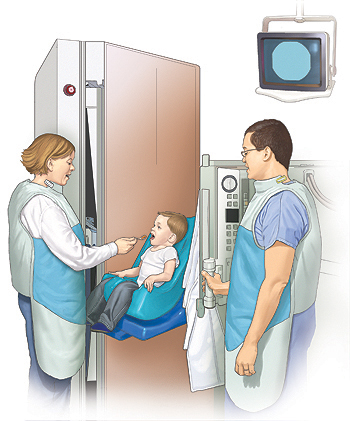
Nicholas failed his most recent swallow study. I don't honestly remember if I posted anything about that but he did. A swallow study is exactly as it sounds. Barium is mixed with things that Nicholas eats (a bottle of formula and some purees) and then he swallows under an x-ray while a radiologist and speech therapist watch to see what happens.


It was frustrating for Mike and I because we had very high hopes that he would pass. His speech therapist was sure he was doing fantastic and was surprised also. What we found out was that he's still silently aspirating approximately 50% of the time. So basically, one out of every two swallows he is aspirating at least some of his food. That's a big issue because when you put food into your lungs you increase the likelihood of pneumonia. It was determined he's still not safe to eat by mouth and that we would schedule another study soon. The speech therapist believes he may have aspirated more than he normally does because he's teething right now and has lots of extra drool. Either way, he's still 100% tube dependent.

I will be totally honest and say that I have viewed Nicholas's g-tube as an albatross around his neck. I know that we had it placed in the hospital to get him discharged because the NICU wouldn't discharge him until he was safe to eat, and eating by mouth was not going to happen (he was aspirating approximately 75% of the time on his NICU swallow study - so huge improvements in only 7 months), so we agreed to the g-tube surgery and learned how to tube feed him. I will admit it's been rough on Mike and I (mostly Mike) to take him to speech therapy two times a week, week after week, and to continually hear that he's still NPO (not allowed to eat by mouth). I sigh every month when his box of supplies arrive and we dutifully put away the bags and pack away the extra Mic-key buttons and g-tube extensions. I try very hard to not let this show because in the event that he needs to be tube fed when he's old enough to realize, I don't want to discourage him or make him feel like he's "different" but it's been frustrating.

Today as we were walking home from taekwando, Zach was talking to me about a conversation that he had with his friend at school. He said, "I told her that I used to go to the hostible a lot and then Nicholas got his g-tube and now he's better and I don't have to go to the hostible anymore." It stopped me in my tracks. Because he's right. We used to have to go to the hospital every day. I used to have to go home every night and leave my youngest child sleeping in a hospital bed ten miles away, being cared for by nurses (phenomenal nurses, don't get me wrong, but not being cared for by us), I used to have to check myself out of the unit to use the bathroom and then scrub in and check back in to see him. Then he got his g-tube and he came home. I had let the frustration of him failing his swallow study consume me to the point that I forgot what the g-tube had once represented - freedom to bring our child home. 


And really, if the worst thing that comes from Nicholas's hydrocephalus is a g-tube, I am pretty sure we are among the lucky ones. If there's one thing my kids have taught me over and over is that everything will happen on their timeline and not one minute sooner. So I will give Nicholas his time. If he never is able to eat liquid by mouth then that's that. If he uses a g-tube until hes 5, that's that. I will stay patient and remember this is not my journey to walk and that getting frustrated will do absolutely nothing but make me frustrated. It certainly won't help a 9 month old learn how to not aspirate. 

Thursday, September 10, 2015

Hydrocephalus Awareness Month Post 5: It IS Brain Surgery

What happens when a shunt is placed?

Shunt placement surgery IS brain surgery. It is among the most common surgery that neurosurgeons perform - upwards of 40,000 surgeries annually. As I've talked about multiple times on this blog, Nicholas was 2 days old when he had his surgery. Because of his age when the surgery happened it was actually an easier surgery (the only time in his life he's had an easier road!). Typically the neurosurgeon has to drill through the patient's skull in order to place the shunt. Since Nicholas was so young, the neurosurgeon was able to go in through his soft spot and place it. As a result, his recovery was easier and the surgery was shorter than typical. 

Shunt placement surgery is typically around 90 minutes and is performed under general anesthesia. Because the surgery team has to go inside the head, the area where they will be placing the shunt is shaved.
A tiny incision is made in the head (older patients get a hole drilled into their skull at this point also), and a catheter is threaded into the brain. The other end of the catheter is then snaked under the skin around the ear, down the neck, and into the area that it's being placed in (most commonly the abdominal cavity). An incision is also made in the abdomen to guide the catheter to the right place (such as not behind the bowels or taking up space the stomach needs). The neurosurgeon then attaches the pump or valve to the catheter to tell the shunt when to drain the CSF from the ventricles. We were warned that a third incision may be needed behind the ear to help guide the catheter around that curve but Nicholas's surgery team ended up being able to guide it without another incision. 

Once the surgery is done, the patient remains in the hospital for recovery. Children are usually required to lay flat for 24 hours after the surgery. Older children and adults may be ready for discharge as early as the day after surgery if there are no complications. Nicholas's neurosurgeon felt comfortable with him being cleared from a neurosurgery standpoint 7 days after his surgery. His extended NICU stint was a result of his feeding issues, not his brain surgery ironically. 

Because the shunt is a mechanical object it is not only common for it to fail, it is pretty much expected to. We were warned of symptoms of shunt failure because leaving a shunt failure untreated can lead to brain damage and even death. Shunts fail more frequently in infants and children than adults. The current average lifespan for an infant's shunt is two years. Older children and adults have a current average lifespan of 8 years. That's a new brain surgery called a revision. Every time a shunt fails.

Tuesday, September 8, 2015

Hydrocephalus Awareness Month Post 4: What does a shunt feel like?

The other day I read a post in one of my hydrocephalus Facebook groups that made me sad and also made me wonder. It was posted, "Does anyone wonder what it's like to not have a device in your head and tubing running down your neck and into your abdomen?" It made me sad because it makes me wonder if Nicholas will feel that way one day (maybe a cure will come in his lifetime!), but it also made me wonder what it actually feels like to have a shunt.

Obviously I can't ask Nicholas yet what it feels like to live with a shunt on a daily basis so I turned to the hydrocephalus community to ask them what it's like to have a shunt. I have a small community of people I know in real life with shunts but am a member of several hydrocephalus groups on Facebook and on Babycenter and they provided me with some insight.

The first thing I was told was that the side effects of having a shunt were far preferable to living with the pressure in your head from having untreated hydrocephalus. That having excess CSF was painful, caused nausea and also made you dizzy. That you experienced things like double vision and just overall felt terrible. Obviously left untreated, hydrocephalus can also lead to brain damage and death, so having a shunt is preferable to that.

Also, I heard very different things from people I asked. Some experienced nothing out of the ordinary that they were aware of and some experienced all of these things - so like hydrocephalus itself, having a shunt feels different for each individual person who has one.

The main things I heard were being able to "hear" the shunt. When a shunt turns on, most people say that they are aware. They can hear it buzzing, clicking, popping, or gurgling inside their heads. This depends on the placement of the shunt (the closer it is to the ear canal the easier it is to hear) and it appears to also depend on the type of shunt (programmable, non-programmable, maker, etc.). Shunts are not always on, they turn on when the pressure in the head indicates they should be. The newer
programmable shunts detect the level of pressure in the head and turn on when the pressure exceeds what the shunt has been programmed to maintain. Older, non-programmable shunts, were on levels of high, medium, or low pressure and would detect when the brain reached the threshold that each shunt was set for. The bad news with non-programmable shunts is that if the shunt is over or under draining, the shunt must be replaced with surgery. Nicholas has a programmable shunt which means if we determine (and we have, several times) that his shunt is under draining, it's an office visit and a strong magnet is used to reset the shunt to a better level.

Another complaint is that when the shunt is draining, if the tubing is placed close enough to the ear, it can mess with a person's equilibrium. Because there is fluid running through a tube near the eustachian tube it can make people feel dizzy. This doesn't appear to be a common side effect, but has been mentioned in the community.


Most neurosurgeons leave a large amount of tubing curled up in the abdomen when treating children (Nicholas's did for this exact reason) so that as the child grows, the tubing can stretch and revisions (more brain surgery) are not necessary as long as the shunt continues to function properly. I have been told that as the child grows, it is typical to feel some tightening or tugging as the shunt tubing breaks loose of adhesions under the skin that were formerly created and lengthen under the skin. I imagine that must be fairly uncomfortable.

Weather is a big one. Most surgeons will tell you that weather has very little to do with the pressure inside the head, but almost every single person I've talked to who has hydrocephalus and is treated with a shunt has said that when the weather changes, they get headaches. It's apparently a big debate within the hydrocephalus community. We have seen it first hand with Nicholas. If a big storm is rolling in, he becomes very uncomfortable and cries. If we give him Tylenol, it seems to relieve and relax him. I've been told by my co-worker with hydro that if it's very hot, she gets headaches. She has found that wearing hats helps to reduce the headaches.


Abdominal discomfort is another common complaint. It seems that the CSF draining into the abdominal cavity creates acid reflux in a significant number of hydrocephalus patients.

While not every person who has a shunt experiences all of these, these complaints come up time and again. And again, every person I talked to said that this is clearly preferable to living with hydrocephalus untreated and obviously better than facing death so they take their side effects with a grain of salt, some ibuprofen, and maybe some Tums.


Friday, September 4, 2015

Hydrocephalus Awareness Month Post 3: Side Effects

The problem with hydrocephalus is that it affects people on such an individual level that there's no true list of side effects from it. There are things that are common amongst individuals affected with hydrocephalus, but people can range from completely high functioning (you'd never know they had hydrocephalus) to total brain damage. It all depends on so many factors, including how early the hydrocephalus was detected, what type of hydrocephalus they have, and what the body did before treatment intervened.

Some of the more common side effects are:

Vision problems, headaches, precocious (or early) puberty, seizures, poor hand/eye coordination, learning disabilities including nonverbal learning disabilities, difficulty understanding complex and abstract concepts, difficulties retrieving stored information, and spatial/perceptual disorders.

Because there's such a large range of side effects, hydrocephalus affects individuals all in a completely different way and on a totally individual level. Since there is no way to talk about all the different ways that hydrocephalus affects every person, I am going to tell you how hydrocephalus affects Nicholas.

The first reassuring thing we were ever told about Nicholas was when we met with his neurosurgeon while I was still pregnant with him. Being told that there's something wrong with your child's brain is terrifying. Meeting with a doctor who will do brain surgery on your child within days of being born? Even scarier. We literally had to trust this doctor with our child's life and we hadn't even met this child yet. Our heads were still spinning as we tried to research what hydrocephalus even was and here we were meeting with a man who would go inside this baby's head. He looked at the MRI and ultrasounds and told us that he was pleased to see something. Nicholas had a giant head. We were so confused. That was a good thing? The doctor told us it was a great thing. Because Nicholas's head was so large, it meant that his brain was growing along with his ventricles. When the head was developmentally normal and the ventricles are large, it means the ventricles are growing into the areas where the brain is and that typically means more brain damage than we would likely see in Nicholas.

I can't tell you how lucky we were that his head expanded. He has some issues because of the hydro, I'm not going to lie. But he's one of the lucky ones. The further we venture into the hydrocephalus community, the more we realize just how lucky this kid is. Obviously we don't know yet if he will have a learning disability or some sort of social disorder due to the hydrocephalus, but as of this moment, his issues are small and manageable.

Nicholas's side effects include a g-tube because of a weak swallow reflex. Weak. Not non-existent. That is a big distinction. He's already showing improvement with lots of speech therapy. The neurosurgery and pediatric team believe the weak swallow reflex is a result of some brain damage due to the hydrocephalus. That was so hard to hear. But he's improving. He had a swallow study on Monday and while he didn't "pass" (there's not really a pass/fail according to the speech therapist that administered it), we were told it was his strongest swallow study yet. That's in only 8 months of having a g-tube and therapy!
Nicholas is being stimulated by electric pulses (it's not painful - he actually falls asleep to this!) to help make his muscles in his neck stronger. This will hopefully strengthen his swallow.

Nicholas is also physically delayed. He has been rolling from back to tummy for about a month and just recently gained enough strength to roll from tummy to back. He will scoot a little bit while he's on his tummy using his legs to push. He just started to push his legs up when you hold him upright with his legs on the floor (i.e. he's starting to try to "stand" while you hold him) and he can hold his head up but not for extended periods of time. All of this is being addressed in occupational and physical therapy. We were told by our neurosurgeon at one time that it's not like it will be on his college application when he walked, and we agree with that. If he doesn't start walking until he's 2, he doesn't. It's not the end of the world.

Occupational therapy = playtime! Fun!

Cognitively, Nicholas appears to be on track, if not slightly advanced in some areas. He tracks with his eyes when you put something of interest in front of him. He reaches for toys and passes them back and forth between his hands. He rolls to his side to grab toys. He babbles and laughs (most often at something Zachary does - this kid sure adores his big brother) and smiles. He's a complete sweetheart and everyone who meets him falls in love.


Wednesday, September 2, 2015

Hydrocephalus Awareness Month Post 2: What is a shunt? Is it really brain surgery?

Once we've explained what hydrocephalus is (and we are more than happy to do so - we like getting the knowledge and awareness out there!), the next question is, if they can't do surgery to remove the blockage, what is the treatment?

There are three different treatments for hydrocephalus, a shunt, an endoscopic third ventriculostomy (ETV), and an endoscopic third ventriculostomy with choroid plexus cauterization (ETV/CPC). ETV/CPC is only available to infants. The decision to treat the hydrocephalus with any of these methods is determined on a case by case basis, and also within a timeline of a patient's life. It is perfectly acceptable to be treated with one method and later in life attempt the other.  

The ETV requires no shunting so some people prefer this method as there is less likelihood of mechanical failure, but if this method fails a shunt is required. The success rate depends on a lot of
individual factors including age of the patient, cause of hydrocephalus, and amount of scar tissue in the third ventricle. It is not recommended typically for infants because their bodies are so dynamic and quickly changing that it frequently fails. Basically, a neurosurgeon goes into the brain and makes a puncture in the floor of the third ventricle so that CSF is allowed to flow through. It effectively bypasses the blockage if there is one. The third treatment option is very similar to this except it includes cauterizing the choroid plexus which reduces the amount of CSF being generated. There are complications to this method including closure and/or infection of the surgically created pathway, short term memory loss as this procedure may affect the hypothalamus, and potentially endocrinologic irregularities since the third ventricle is responsible for some hormonal function. For individuals that this works for, however, the success rate can be up to 90%.

The shunt method involves a surgical implantation of a shunt. A shunt is a tube that diverts CSF into another region of the body, most typically the abdominal cavity, where it is absorbed and removed. A valve inside the shunt helps maintain normal pressures within the ventricles. The shunt that drains into the abdominal cavity is called a VP shunt (ventriculoperitoneal). The other type of shunt is a VA (ventriculoatrial) shunt which drains into the right atrium of the heart. This is not a preferred placement and is only tried after there have been several malfunctions of a VP shunt. There are
several complications with a shunt system, the most frequent being shunt malfunction. Shunt malfunction is most often caused by a blockage that stops the shunt from being able to function properly. Blood cells, tissue, or bacteria can all create a blockage. Shunts can also malfunction because it is a mechanical device or because it becomes dislodged from its original placement. Shunts can become infected, though this typically occurs within 6 months of the placement. In any of these instances, the patient must have another brain surgery to get a new shunt placed. This is called a shunt revision.

Other shunt complications include under or over draining. This can usually be treated by changing the pressure on the shunt. Abdominal and/or heart complications can also occur depending on where the shunt drains into. Obviously abdominal complications are less severe than heart complications.

Nicholas had a shunt placed on the second day of his life. His neurosurgeon prefers to shunt children

and considering he has the highest success rate of hydrocephalus treatment in the southeast, we trusted his judgement. His goal is to place a shunt once in a child's life and have it last until the child is at least 18. He is successful in that goal in 40% of his patients. Nicholas's surgery was fairly uncomplicated and quick. The neurosurgeon told us that it's easier in babies in that they have a soft spot to go in through, whereas in adults he has to drill through the skull. Nicholas has a scar on his head where the shunt was placed and then also a scar in his belly where the end of the shunt was placed. Most people think that his shunt drains into his stomach, but it doesn't. It drains into the area around his stomach and is absorbed and removed by his intestines. Nicholas has not yet (knocking on wood) had a shunt malfunction but he has had some abdominal complications that involved a hospital stay and several x-rays and ultrasounds. He has had the pressure reset multiple times on his shunt as his neurosurgeon tried to drain the massive amount of fluid he was born with and then to normalize the pressure in his head to remove the optimal amount of CSF.

It is not uncommon for patients to have multiple surgeries with hydrocephalus. There are people who have had hundreds of surgeries and then there are some who have lived with the same shunt for decades. There is no rhyme or reason to why shunts fail multiple times in some people and work like a dream for others. We hope that Nicholas is in the latter group, but the honest answer is we just don't know. We are asked frequently if he is done having surgery and we just don't know. We hope so, but the likelihood is that he will have brain surgery again at some point in his life. Maybe more than once.