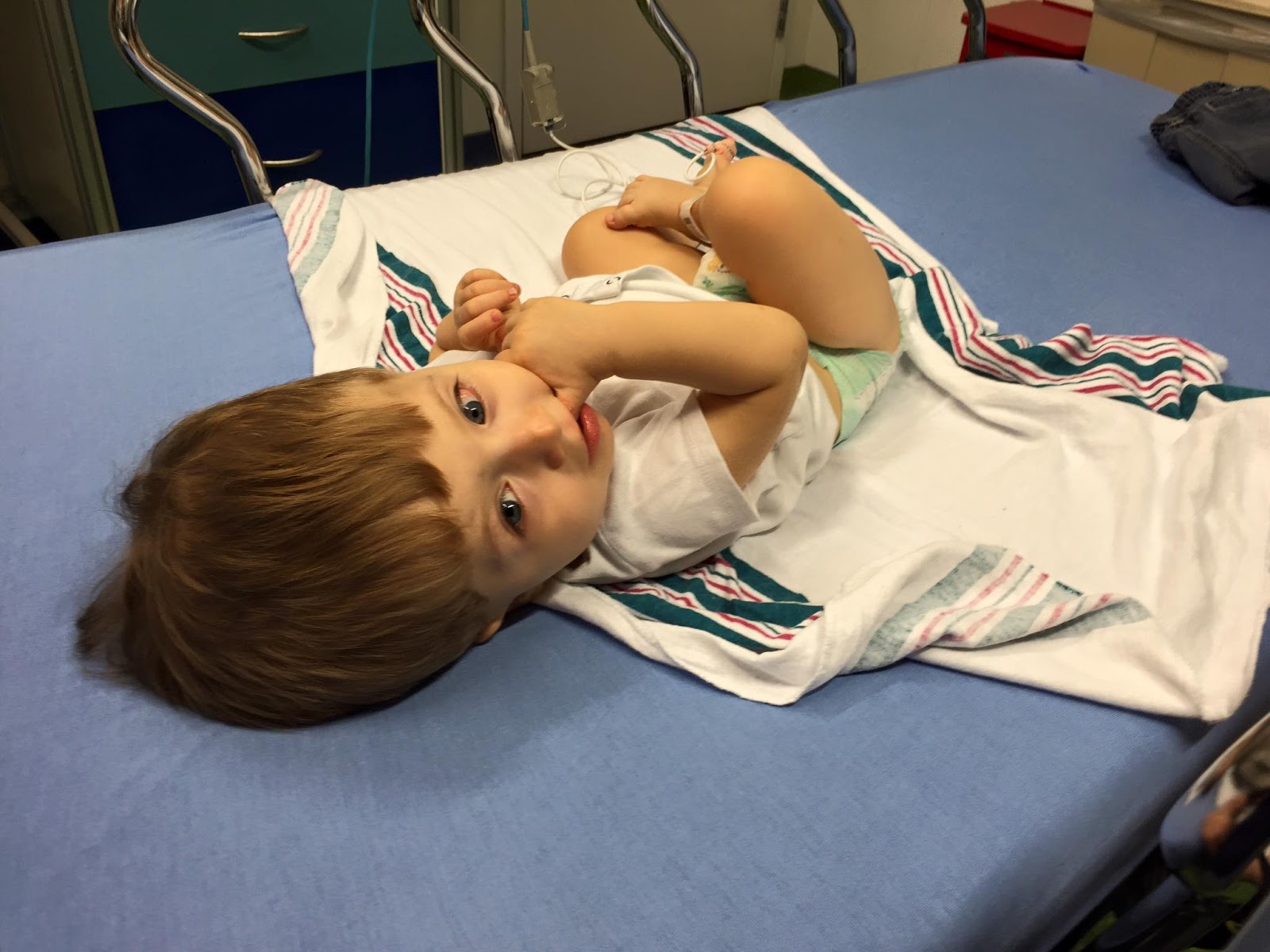
Showing posts with label hospital. Show all posts

Monday, September 26, 2016

Whoops I Did it Again

Things have been absolutely insane around our household and I have been terribly terribly remiss in updating. I apologize and promise that it's been mostly good news that kept me away!

In mid-August, I started my new job. While it's a big change from what I'm used to, it's really a fantastic company to work for and it's great to feel challenged to learn something new. With the new job came many new things for our family - for the first time the twins are in daycare. We found a school that specializes in special needs children but also accepts "typical" children, and luckily they had space for both Emily and Nicholas! We've seen leaps and bounds of development from Emily who is now trying very hard to talk. She's doing very well, and is even attempting sentences now! Nicholas is trying to emulate the older kids (they are in a classroom for 18 months to 3 years old and are the youngest of the group), and we've noticed him verbalizing a significant amount also, along with working on ways to get from point A to point B more efficiently and voluntarily going to a standing position.

Also with the change, Mike was able to move back to a day shift at work which has been amazing for our family. We can actually eat dinner together most evenings (he still works news - breaking stories still happen), he gets to be more involved in Zachary's taekwondo, and we actually feel like a family again.

Things have been pretty quiet here, albeit incredibly busy with life, but nothing out of the ordinary until recently. We had noticed that Nicholas's g-tube was leaking a little. We mentioned it to his pediatrician at his 18 month check up and they told us that the button may be sized a tad small since they've never resized since he had his g-tube placed at 3 weeks old, but that we would keep an eye on it. A brief lesson in g-tube sizing: Nicholas was wearing a 14 french 0.8. That means the part of the tube that actually goes through his abdominal wall into his stomach was 14 french (a form of measurement) around and 0.8 mm long. We noticed the leaking getting worse, so we went ahead and changed the tube. It continued to get worse until almost every feed, he would leak so significantly that his entire shirt would be soaked and smell of stomach acid.

On a Sunday morning, we noticed that his belly around his g-tube site was red and raw. He was screaming in pain every time we fed him. We called the on-call pediatrician who told us that the children's hospital emergency physicians are all trained on g-tube resizing so we should take him to the emergency room to have it looked at. He also mentioned that if we didn't feel comfortable with the emergency room physicians resizing the button, the general surgeon who placed Nicholas's tube originally was actually on call and in the hospital that day. Mike whisked off to the emergency room for what we figured would be an easy fix. After several hours (things do not move quickly in hospitals), they were home. Nicholas had a freshly placed 14 french 1.2 button. He was past due for a feed, so we set him up and started the feed. Nicholas immediately began screaming in pain and the hole where the g-tube button is began leaking so badly that we were actually unsure if any of the feed was even making it into his stomach. Mike packed Nicholas up and took him back to the ER. The surgical resident came down and looked at his g-tube. He decided that Nicholas appeared to be between sizes - he thought a 14 french 1.0 would be too small but a 14 french 1.2 was just slightly too big. Unfortunately, there is no such thing as a 14 french 1.1. He left the decision up to us, but suggested we stay with the 1.2 because scar tissue would form and until then, we could pack the site with gauze to kind of build up the distance and hopefully stem the leaking. He was wary of switching the tube again simply because Nicholas was already in so much pain that he didn't want to add to it.

We took his suggestion and called the surgeon's office for a follow up visit. We were able to sneak into an appointment on Wednesday and the surgeon ended up changing the tube at that visit back down to a 14 french 1.0. At that time, Nicholas was diagnosed with a chemical burn from the stomach acid leaking out of the g-tube site. He was prescribed a topical ointment and we were told to attempt to let the site air dry as much as possible.

By Friday afternoon, we thought things were getting better. As I sat in the chairs at Zach's taekwondo class, Nicholas became very agitated. I was holding him, trying to calm him down, and I realized his onesie was soaked through again. I took him to the bathroom to try and get some cool water on his belly until we could get home and I could change him and fix the dressings and that's when I realized that blood was pouring out of his g-tube site from beneath the button. I asked the director of the school if Zach could stay there (he had demo team practice later that evening) until Mike could get off work and meet him there, grabbed Emily and Nicholas and headed to the hospital. Zach was treated very well while I was off - hanging out with his favorite instructors and fed delicious food from a mom of his friend who graciously took it upon herself to run to Publix and pick up some food for him.

The ER doctors consulted in the surgical team again who decided they would like to see an X-ray just to make sure that at some point during all the button changes over the past week that his stomach hadn't disconnected from the abdominal wall and that we had just been feeding his abdominal cavity for a week. This can happen early in the g-tube placement process as scar tissue hasn't formed to adhere the stomach to the abdominal wall yet, but is a highly unlikely possibility after having had the tube for almost 2 years, however, we agreed with the surgical team - better safe than sorry.


The X-ray found that there to be no problem with the placement of the tube and it was decided that the bleeding was from irritation of the chemical burn. I had made my way back to taekwondo to pick Zachary up from demo team practice (and brought Emily back with me), so Mike was sent home with wound care instructions. The tube is still leaking somewhat, thought it's not nearly as bad as it was during this time. We've gotten the worst of the chemical burn under control, though it's still healing. The best conclusion we can come to is that it was a combination of things - the initial tube too small, transferred into a tube that was two big and allowed for significant leakage over three days before it was switched back out. Beyond that, he's currently getting his molars, so he's had more spit to swallow and because molars really suck to get, he's been crying more frequently than he normally does. Crying causes him to bear down, and may be contributing to the leaking.

Hopefully this will eventually just be a blip on the radar pretty soon. I feel like we're getting close to the end, but it's been a frustrating process.


Monday, December 14, 2015

525,600 Minutes

In one week the twins will turn one. When I think back over this whirlwind year, I can't help but feel like we are so incredibly lucky. 


The first month of the twins lives was hectic and scary. Nicholas underwent two major surgeries and spent 21 days in the NICU. I've learned that's a heartbeat in the NICU. He was a short timer. But for our family that was an eternity. Zach befriended child life, figured out where the playroom in the children's hospital was, learned where to touch on the magic wall in the lobby to make music. He quickly learned how to pull out the blanket child life left for him and play with the toys in "his" bin. And what day there was good stuff in the parent lounge fridge. 

Emily slept in the arms of nurses, doctors, therapists, aunts, grandma and parents as we sat for hours next to Nicholas's bedside. 


Mike and I found the healthier cafe in the hospital, learned how to scrub in properly, quickly learned medical terminology, learned how to navigate a "normal" life as we carried around a feeding pump, feeding bags, extensions. We learned how to replace a button in our son's stomach so he could always eat. We watched therapists work to increase Nicholas's strength and learned what they were doing so we could do it at home. 

We enrolled Zach in taekwando so he would have something for himself and we have watched him blossom into a remarkable child. He is a fiercely protective older brother, a patient playmate, and has most recently become a victim of his sister's experiments with biting. He is independent and excelling in school even though he's one of the youngest in his class. 


Emily is growing into a stubborn and independent toddler. She is crawling everywhere and getting into everything. If there is something she shouldn't be putting in her mouth anywhere around her she is guaranteed to find it and put it in her mouth before anybody realizes. She is friendly and likes people. She spends a lot of her time with her brother at therapy and benefits from playing with the toys there. 

Nicholas has had the hardest year of any of us (and it isn't over yet as he has a minor surgery scheduled December 31st to remove a cyst from his nose) and still remains the happiest, sweetest child. He willingly smiles at everyone, he laughs at pretty much anything his big brother does, loves to pet our dog, and is getting around by rolling all over the place. He is currently anywhere between 3-5 months delayed but is making incredible strides every day. His therapists are amazed at his successes. 

It was probably one of the hardest years of our lives for Mike and I. Between working opposite shifts, planning around hospital stays, fighting insurance, and buying a home, we've spent a significant portion of the year at stress level maximum. But we are so very lucky. We get these amazing examples of tiny people to love and raise. It's not an easy job, and with the independent streak running through all three of them, it will probably get harder but it's a pretty fantastic life. 


And I can't believe we will have TODDLERS in a week. 

Monday, May 18, 2015

Here We Go Again

When Nicholas had his hospital stay a month ago, we had been asked if we had ever noticed his pupil sizes were different. We really hadn't, and at the time figured that, with as many medical professionals as he had involved in his care, someone would have noticed that before a hospital stay. It was eventually decided that it was likely a side effect of the pressure changes from the big change in the shunt and that it should resolve itself.

Saturday morning, I was rocking Nicholas back and forth in my arms because he had been very fussy the whole morning and he was staring up at the ceiling. I noticed that he was tracking something on the ceiling with his eyes but that when I moved him to a certain spot, his eyes would sort of jerk back to the center. It was a very rough movement and I was a little concerned and decided to watch it. We ended up going to lunch and Mike noticed while we were there that his pupils were still different sizes (they've not been the same size that we've noticed since the last hospital stay) but that the sizes were very pronounced. One was very small and the other was very large. We googled (you should really never do that!) and found that one of the main symptoms of a brain bleed is different sized pupils. That combined with the fussiness got us a little worried.

We called the on-call pediatrician who asked us to call the on-call neurosurgeon (NSG). The NSG who had placed Nicholas's shunt actually ended up being the on-call this weekend in a stroke of luck. He told us that if our guts were saying to get him checked out, he agreed with us and suggested we head to the emergency department.


We got to the ED and the doctor came into our room almost immediately to check his eyes. She stated that one of his eyes was reacting sluggishly and was slow to constrict under light. She asked if he would need sedation for a CT, we confirmed he did not, and the nurse whisked him and Mike off to Radiology. About an hour and a half after he returned, the new doctor (somehow we always show up during shift change!) told us that while they hadn't seen anything worrisome, they wanted to admit him overnight for observation. They brought us upstairs to the Pediatric Intensive Care Unit (PICU). We asked why he was being admitted to intensive care and were told that because things can go from fine to terrible in a very short time due to his medical complexities, they wanted him under the care of a higher level unit just in case. Made sense to us.

Early Sunday morning, the NSG came in to see Nicholas before I got there (Mike was there having spent the night and getting almost no sleep). He confirmed that the shunt was working perfectly as far as he could tell but that he was wondering if Nicholas was having some seizure activity. We had been warned even before Nicholas was born that people with hydrocephalus are at higher risk for seizures and so we were not surprised by this. Worried, of course, but not surprised. The NSG suggested to the floor PICU doctor that they consult in a neurologist and order an EEG to see what was happening.

The neurologist ordered a standard EEG. I had never seen an EEG before, but it was a little unnerving to watch. First, they measure his head to determine where to place the leads. Then many leads are "glued" to his head and once those are all placed, gauze is wrapped around the leads to make sure that nothing moves. The first part of the EEG involves placing a strobe light very close to his face and strobing at varying speeds. Essentially, they are trying to force a seizure to happen so they can catch it on the monitors and the neurologist can determine the best method of treatment. Nicholas actually loved the strobe lights. He was very upset when he started the test but every time they turned on the strobe lights, he stopped crying and just stared at the lights.


We had to wait for the neurologist to read the results. Once he read the results he came and met with us. He ended up meeting with Mike because I wasn't there, but we found out that there had been no seizure activity whatsoever on the EEG! Fantastic news! Mike asked why the pupils were different sizes and the neurologist said that's actually a variation of normal and that sometimes you can see it more prevalantly from a certain angle or in a different light. We asked why the pupil had been sluggish and the neurologist said that he couldn't answer with 100% certainty but that he wasn't concerned because since being admitted, his pupils had been equally reactive, so they were unable to duplicate what the ED saw. The theory he came up with was that he believed Nicholas's shunt may have turned on and that's why the size difference was more noticeable and likely also caused the sluggishness.

We also asked about looking for seizure activity in the future. The neurologist stated that in the vast majority of hydrocephalus cases that he has observed, if the patient was going to be prone to seizures, it would happen almost immediately after the shunt placement. Since Nicholas has had the shunt for almost 5 months and since they did everything they could to try and force a seizure and he hadn't had one, he felt like we were in the clear for seizure activity in the future. Good news for once!

With both the NSG and the neurologist deciding that Nicholas had no issues that required intense follow up care, Nicholas was discharged. We were told by his nurses that they loved him but they really didn't want to see us again and we echoed the sentiment.

Friday, April 24, 2015

On This Road

There's no way to describe the way you feel when the doctor tells you, "We see something wrong," while looking at an ultrasound. Your heart drops. You grasp your husband's hand, you stare at the grainy images they're showing you, trying to make sense of light and shadows. When those words "We see something wrong" includes the word brain, it gets really scary. A big long name for a condition we had never heard of. Hydrocephalus. Prognosis is typcially good. You cling to the word typically but live in fear of the atypical. Of the outliers. Of the ones who don't have a good prognosis. You vow to help him fight, to help him live the best life he can.

The day he's born. You barely see him before he's whisked off to be cared for by someone else. Your child being placed into someone else's arms. Someone else leaning in close and providing warmth. You're laying in a cold operating room with no answers. Your heart pounding, the worst case scenarios running through your head. Asking the doctors for answers and being told they have none yet. You'll get them they promise but not right now.

Standing in the NICU next to his bassinet and hearing "Not swallowing the way he's supposed to. Swallow reflex not working. Probably some damage to his brain. Hydrocephalus." Suddenly your vision of your future, and his, comes crashing down around you. The future you've always envisioned is raising happy children that leave and live lives with their own families, their own careers. Brain damage may change that future. Certainly you'll love him with everything you have forever, but that future may include him by your side for the rest of it. And what to do when your future ends but his keeps going? What happens then? Your resolve to fight slips a little. It's a scary time to hope, but what choice do you have? You start therapies. You agree to another surgery. You do everything the doctors and nurses tell you because it will help.

It's terrifying to go through. It breaks your heart because all you want is for your child to be happy. All you want your child to know is love and joy. And while you know that's not possible for his whole life, you'd really like to think it is possible in the first three weeks. And you feel guilty that your child has to know pain. And fear. And be poked and prodded. And x-rayed. And have ultrasounds. And have a PICC line placed. And you know that all of this is to help him. But he doesn't know that. He has no clue.

Then one day he does this.


And two days later he does this.


And you compare this.


And you start to feel sparks of true hope. And you start to allow yourself to consider that word typically again. Typically good prognosis. And you realize that what they told you in the NICU, "Nicholas hasn't written his story yet. He's writing it every day. There is nothing set in stone." is being proven to you by leaps and bounds. By a baby who doesn't know any better than to fight. And your resolve to help him fight that you thought you had lost? You realize it has been there the whole time and has become so ingrained that you don't have to think about it anymore. And you realize that nobody's future has been written yet and it is never never wrong to cling to hope.

Tuesday, April 14, 2015

Answers

Nearly a week after his discharge from the hospital, I am finally able to write about the stay. As previously written, we weren't exactly sure what was going on with Nicholas, but it was clear it was getting worse. Friday afternoon Mike noticed the hardness in his belly, brought him on an impromptu visit to the neurosurgeon's office, was advised to go across the street to the children's ER, and Nicholas was admitted.

Over the weekend very little happened which was incredibly frustrating. Certainly I understand it was a holiday weekend, but a hospital is a 24/7/365 atmosphere and if a physician is not prepared to work in such an environment then he or she should not have gone into the field they did. It is crazy to me that we had to wait until Nicholas's pediatrician was back Monday to start getting answers. It's also incredibly unfair to the patient. The longer he was in the hospital, the longer he was away from his family and the greater chance that he could be exposed to something, making him even more sick than he was.

They reduced his feeds to 30 ml/hour for a full 24 hours. This was to ensure that he received full nutrition without causing him the pain that the feeds seemed to cause. He tolerated this, though we didn't really care for the solution and his pediatrician agreed. They were treating the symptoms rather than determining the true cause of the problem.


Monday morning, the PA who works directly with the neurosurgeon we see came in and looked at Nicholas. They decided to turn his shunt from a pressure of 50 to a pressure of 60. This should lessen the drain of CSF from his brain and hopefully help to relieve some of the belly pain causing feed intolerance. Monday was the worst day. When I got to the hospital after work, I was told that Nicholas had moved from needing Tylenol every six hours to needing it every four hours. At around 8 p.m. as I was packing up Zachary and Emily to leave (I stayed long enough to meet the night nurse and then had to take the other kids home), Nicholas started crying and became inconsolable. His heart rate was skyrocketing and it was clear he was in pain. I got the nurse and a decision was made to give him a suppository since he hadn't had a bowel movement all day and also to give him 1 ml of ibuprofen. I was very worried because I've always been told that you shouldn't give an infant under six months of age ibuprofen but the nurse reassured me that it was such a small amount it shouldn't affect him at all. After the suppository (which worked fantastically) and the ibuprofen, Nicholas calmed back down and went back to sleep. It was only then that I felt comfortable leaving.

Tuesday, the pediatrician told Mike that we would have answers today. The neurosurgeon rounded on Nicholas's floor and saw Nicholas. He determined that he was going to back out of the care of Nicholas since the shunt appeared to be working correctly. Since the neurosurgeon's place of expertise is the brain and the placement of the shunt, it was appropriate for him to give up the lead role in Nicholas's care once he determined that his area of expertise was working properly. I was still incredibly angry and frustrated and ended up leaving work to go to the hospital early in the hopes of meeting with some of the physicians. I was prepared to go full mama bear. The pediatrician ordered a STAT belly ultrasound since the hard spot on Nicholas's belly hadn't been looked at since Friday when he had the ultrasound and CT scan. Nicholas's nurse from his pediatrician's office came up to the room to meet with us, and listen to my complaints. Ultrasound came up and then we waited for the results. Nicholas's nurse called the room to let us know the pediatrician was currently seeing an outpatient patient in clinic, but they would be up shortly. She called again about an hour later to let us know that he had been held up, but was on his way now. He was going to stop by radiology for the ultrasound results and also consult in the general surgeon who had placed Nicholas's g-tube and done the nissen but he was on his way to talk to me.

The ultrasound revealed that the spot was virtually unchanged but confirmed that it was, in fact, a pocket of cerebral spinal fluid in between the layers of the skin. The pediatrician told me that the surgeon had promised to stop by and talk to me before he left for the day. He asked the nurse to call the surgeon if he hadn't appeared by shift change at 7 p.m. The nurse assured me that she would call as soon as the pediatrician left and not make me wait until 7. As the pediatrician walked out of the room, he ran into the surgeon and the surgeon's resident, so all three came in and a 45 minute discussion ensued where I got all of my questions (and some I didn't think of) answered.

The surgeon assured me that the pocked of fluid was nothing to be worried about and that it was causing Nicholas absolutely no pain or discomfort. He told me it was like a room with one door and when Nicholas was upset or pushing for some other reason, the fluid all rushed into the room and none could get out because the door was occupied. He proved to me that there was no pain by pressing on the site to remove the fluid from the pocket. Nicholas didn't even whimper. He said that he didn't recommend surgery for the spot at this time because fluid has a funny way of being able to get around stitches. He said that Nicholas basically felt like he had the worst hangover he would ever experience because of the pressure change. He said he would be grouchy and irritable and likely not wanting to eat because he felt terrible. Pressure changes did this, and should he ever need the pressure changed again, we should expect it. I verified this information later with my employee who has hydrocephalus and a shunt and she agreed. She said whenever she's had pressure changes she has felt horrible for about a week. After speaking with the surgeon, I felt much better about not going forward with surgery and also with the ultimate outcome of this situation.

It was decided that we would try to reduce Nicholas's feeds from continuous to being fed over a period of two hours and off two hours. The pediatrician didn't want to send Nicholas home on continuous feeds if we didn't have to. Wednesday, they reduced him to feeding over two hours and Nicholas tolerated it like a champ. He also went the entire day without taking Tylenol once. I got a call from Mike in the early afternoon and he told me that their goal was to get Nicholas discharged home by 8 p.m. I was ecstatic. If he tolerated all of his feeds before then, they felt comfortable discharging him. When I got there he had just finished a feed, so his next feed would start at around 4:30 p.m. If he could tolerate that, he would go home. As 6:30 p.m. rolled around, the nurse came in with the discharge paperwork. I was packing the room as they unhooked him from the feed and by 7 p.m. we were saying goodbye to the nursing staff and heading towards the parking lot.


We have since moved his feeds from over 2 hours to over 1 hour. Before the shunt adjustement, he was eating over 30 minutes every four hours, so we're hoping to move the feeds back to that schedule soon. He has a follow up with his pediatrician tomorrow but is back to the happy and sweet baby that we have known until the shunt adjustment. He's talking and cooing again, smiling, kicking... Basically doing all the baby things he's supposed to be doing. And it's much nicer to be spending our time at home (or at Zach's taekwondo studio) rather than at the hospital.

If Nicholas has taught me anything, it's to expect the unexpected and to roll with the punches.

Tuesday, April 7, 2015

Happy Easter?

This weekend was hectic and frustrating, to say the least. It was a roller coaster of emotion as we thought we would get an answer and then someone else would be consulted in. It seemed that both the neurosurgery and general surgery staff members were certain the other was responsible for fixing whatever was wrong, and nobody wanted to make an official decision. Late Saturday night, Nicholas was moved to a different, much larger room on the same floor. We no longer feel like sardines, and Mike had an actual couch/bed to sleep on rather than a recliner. Still not comfortable, but slightly more.

Easter Sunday, I took Emily and Zachary to a friend's house for her annual Easter egg hunt and brunch. It was a nice break and Zach got to play with his friends and not be in a hospital for a few hours. While we were enjoying our egg hunt and brunch, the Orange County Sheriff's office came around the unit and brought the Easter bunny in to meet Nicholas. He got a stuffed bunny and they also left a coloring book and some crayons for Zach.


When we got back to the hospital, the speech therapist we had initially worked with when Nicholas was in the NICU was in the room working with him. Mike had spoken to the nurses and asked if we could get speech and occupational therapy involved in his care since he would be missing the appointments while in the hospital and it happened very quickly. The speech therapist was impressed with his improvement since leaving the hospital.

We didn't see anyone from the neurosurgeon or the general surgeon's office on Sunday and everything seemed to be at a standstill. The occupational therapist came in and also expressed happiness with the level of improvement Nicholas had since leaving the NICU. She said with the exception of his not being able to hold his head up consistently, he was advanced for his age.

Around 6 p.m. Nicholas started screaming and became inconsolable. His heart rate increased to the point of tachycardia - at one point, his heart rate was above 200. His nurse rushed in and gave him some more Tylenol. After about an hour he finally calmed down, though he continued to whimper until he fell asleep. His pain is clearly still not manageable and we told the night nurse when she came in that we needed to make sure the Tylenol stayed on board. Mike came home to sleep Sunday night since I was going back to work this morning and he needed to have the other two kids. We felt guilty leaving him there at the hospital, but his night nurse assured us she would check on him every two minutes if she needed to.

Yesterday, Nicholas's pediatrician came in to check on him and was very angry with the way that things had been handled over the weekend. He assured us that we would have at minimum a care plan today and was going to try and find us answers about why Nicholas was in so much pain and not tolerating his feeds. He was angry that the solution to his pain was not to figure out what was going on but to change the feeds to continuous. He felt that was treating the symptoms and not the problem. He consulted with the PA who works directly with the neurosurgeon who put Nicholas's shunt in and also the general surgery department. It was decided neurosurgery would take the lead since the issues started when the shunt was turned down.

The PA came in and they turned the shunt back up slightly to see if this would slow down the drain into his belly and relieve some of the pain. The pediatrician also ordered his feed to be turned back up slightly. Mike took Zach for some lunch and when he came back Nicholas was crying again. Mike asked the nurse what happened and she said "they turned his feed back up". The PA came back in and felt that the protrusion from the belly was larger again. 

When I got to the hospital after work, mike left to go to work and Nicholas was asleep. He woke up and started screaming again. It was time for his next Tylenol dose on the dot. The day nurse left and the night nurse came on. Nicholas's nurse from his pediatrician'so office texted Mike and told him that the neurosurgeon would be by in the morning to examine Nicholas and go forward in some direction. 

Around 7:30, I was packing up to leave and Nicholas became hysterical. I found his nurse and we were both worried because it had only been two hours since his last round of Tylenol. He couldn't have more but he was obviously in pain. She called the doctor and got permission for a one time small dose of ibuprofen. She also felt like he was straining when she picked him up so she called for a suppository. That must have been the issue. Once the suppository worked he calmed down immediately and fell asleep. I packed up the other two and we headed home. 

We, along with the pediatrician, will be demanding answers today from the neurosurgeon. And action. 


Saturday, April 4, 2015

One Step Forward Two Steps Back

Well, as soon as I hit "Publish" on that last post, things changed. Of course. Because if we've learned anything from these almost 4 months of Nicholas's life, expect the unexpected.

After the shunt was turned down on Wednesday, Nicholas was immediately fussy. He wasn't tolerating his feeds very well. He just wasn't acting like himself. We put a call in to his nurse and she said this was typical behavior for someone who just had the pressure in his head changed. It's a big change and it makes them feel yucky for awhile. Basically, he could be agitated and he probably wasn't tolerating the feeds as well because his belly was full of the cerebral spinal fluid the shunt was rapidly draining from his brain. If it continued past the weekend, let them know.

We had previously noticed a slightly hard spot on Nicholas's belly right between the two incision spots (one from the shunt placement and the other from the g-tube placement and nissen). We had mentioned it to his pediatrician the previous Friday, and they agreed it was slightly abnormal but that they weren't concerned and we would keep an eye on it.

Friday, Nicholas had his speech and occupational therapies. We had noticed the spot on his belly had grown and was now protruding. Mike felt Nicholas's belly after therapy and discovered it was rock hard. Nicholas had been inconsolable all night Thursday night and most of Friday morning. Since the neurosurgeon was in the same office building as the therapy, Mike decided to head up to the fifth floor and see if they could take a brief look at him. Both Nicholas's neurosurgeon and his partner were in surgery, but the medical assistant came out and looked at Nicholas. She became very concerned about his belly and asked Mike to take Nicholas across the street to the emergency department immediately.

Mike got into the ER very quickly (our hospital has a separate children's ER) and I left work to come over as well. A CT scan, shunt series, and abdominal ultrasound was ordered. As soon as I got to the room, Mike and Nicholas left for radiology. I stayed in the room with Zach and Emily. The CT and shunt series came back normal and showed the shunt is continuing to work very well. The abdominal ultrasound showed what appeared to be a cyst in his belly and the decision was made to admit him to the hospital to see if the cyst could be drained. They also ordered a CT scan of his belly to get a better picture of what was going on.


Mike ended up staying Friday night with Nicholas while Emily, Zach, and I went home. Not much happened overnight except that he did not tolerate his feed at all. Mike only got 60 ml (half of his normal feed) in while he screamed. After midnight, he was not allowed to eat anything in preparation for the cyst to be drained in the morning.

This morning, we received a visit from the PA in the neurosurgeon's office. She felt confident that the shunt was not the root cause of the issue and wanted to consult in general surgery to see if they felt the catheter of the shunt that lays in Nicholas's belly needed repositioning or if they felt the problem was something else. After awhile, the surgery resident came in and told us that after further review of the belly CT, they felt it was a pocket of CSF that had gotten stuck and appeared to be subcutaneous and therefore shouldn't be causing pain or the intolerance of feeds. He stated that his gut indicated that it was something else and he wanted to get the surgeon to review the tests and they would be back, hopefully with a plan. We were prepared that he may be scheduled for an exploratory laparascopy.

The surgeon came in and examined Nicholas. He agreed that the spot on his belly was likely not the cause of the pain and feed intolerance and ordered an upper GI scan to make sure that there wasn't a blockage somewhere in his digestive system. Nicholas was whisked away to radiology again. He was given barium with contrast through his g-tube and pictures were taken. Then they waited a half hour to complete some more pictures - they were trying to see how well the contrast moved through his digestive system. The answer came back that he has no obstructions in his digestive system. But...we still don't know what is causing the issue.

When he came back, his nurse came in to complete vitals and asked us if we had ever noticed his pupils were different sizes. We had not, and were pretty sure if they were, some medical professional would have noticed by now, as many as he had seen. The floor attending was called in to look and confirmed that one pupil was significantly larger than the other. The neurosurgeon's office was paged again and he was placed on full monitors. They weren't overly concerned, because he had no other symptoms that indicated potential neurological problems, but they wanted to watch him on full monitors just in case.

We asked about getting him fed, because at this point it had been 18 hours since he last ate. The nurse asked the floor attending who said we had to talk to the neurosurgeon who said that we had to talk to the general surgeon. The general surgeon approved him for feeds but suggested that we slow his feeds down from 4 ounces every four hours to a very slow continuous feed over 24 hours. We said okay, sounds good to us and the nurse laughed. She said that order has to come from his pediatrician so we have to page them. Finally, he was started on a continuous feed of 30 ml/hour for 24 hours.

That's where we stand right now. We don't know what's wrong with him, though there have been plenty of ideas tossed around, from a kink in the shunt catheter to the idea that perhaps the shunt catheter has grown into the scar tissue from the surgeries he's had. The honest answer is that he will likely require surgery again for them to get in there and figure out what's wrong. And that sucks. That sucks so bad for our little guy. It sucks that he's had to endure so much in the short 4 months he's been here. The good news is he's little enough that though the memories of this will be forever burned into our minds, he won't ever remember this. Hopefully we'll have figured out the big issues by the time he is old enough to remember and hospital stays and surgeries and radiology will be something he knows very little about.

I'll update when we know more.


Friday, March 6, 2015

Back at the hospital

Nicholas has a different pediatrician than his brother and sister. Because of his needs, he is seen by a doctor that speciizes in high needs kids and is also directly connected to the hospital. We have a nurse that we can contact directly (we text her frequently enough to feel slightly guilty though she promises that it's always welcome), and receive a very high level of care. Not that Zachary and Emily's pediatrician doesn't provide fantastic care, Nicholas's is just so much more specialized.

He had had a bad night. Fussing through his feed, moaning the whole night. Mike had stopped his continuous overnight feed more than once to vent him, hoping some of his discomfort was due to being gassy. Because of the nissen, it was nearly impossible for Nicholas to burp his gas out. Instead, we connect an empty syringe to his extension tube (which is connected to his button) and the gas escapes that way. It comes with Nicholas pushing the contents of his stomach into the syringe, which we then let gravity drain back into his stomach. 

Each time he was vented, significant amounts of mucous came with it. In the morning, we decided to get in touch with his nurse to find out what she thought. They decided to have him come into the clinic to take a look at him. Mike packed him up, I stayed home with Zachary and Emily and off they went. 

After about an hour of being gone, Mike called me. They had decided to admit him to the pediatric floor. Apparently when they measured his head circumference, it had increased by 2 cm. That, combined with the fussiness, and the apparent discomfort was concerning. They were worried that his shunt had failed and the pressure was increasing in his brain again as cerebral spinal fluid was unable to leave. A CT scan was immediately ordered. And now we wait. 


The next morning, the PA from the neurosurgeon's office along with Nicholas's pediatrician reviewed the CT scan. The ventricles were smaller than they had ever been and more brain was visible than they had ever seen before. When the ventricles are enlarged, they push the brain out of the way. This was actually a very encouraging result. 

A shunt series was ordered. This is a series of x-Rays that look at the shunt from top to bottom to make sure that nothing has happened to the catheter. Maybe a kink in the line? Maybe it broke off somewhere? Shunt failure or malfunction is one of the most common problems with hydrocephalus. We were praying it wasn't that. The only fix is to place a new shunt. Which means another brain surgery. The shunt series showed a perfectly intact shunt, another promising result. 

The next test was to find out the pressure in Nicholas's brain. This would show if the shunt was working for sure. This required a needle to be placed into the area where the shunt is to measure the pressure. Normal. It appeared that the shunt was still doing its job and Nicholas wouldn't be in surgery. 

Because they were preparing for possible surgery, they had stopped all feeds the night before. After not feeding for 12 hours, Nicholas took his first feed like a champ with no fussiness or apparent discomfort. 

We still don't know why his head circumference increased or why he was so fussy but he was discharged home again.


Wednesday, March 4, 2015

The Second Night Home

Mike had gone back to work before Nicholas came home, but we had had family with us so I was getting help with Zach and Emily while he worked.

My mom was still in town the second night home and thank goodness she was. We put Zach to bed, watched some tv while I got Nicholas his feed and nursed Emily. Just before 11, I moved the babies to the pack and play in the bedroom, packed up the IV pole with the feeding pump attached and my mom and I said goodnight. As soon as I got into the room and started Nicholas's overnight feed, both babies started to cry. I tried calming them down but they appeared to be hearing each other and winding each other up. I wasn't sure how to hold both babies and I couldn't get either to stop crying. Getting a little panicked, I called out for help from my mom. She came in and took Emily to the other room. That seemed to do the trick and I was able to pick up Nicholas and bounce him enough to calm him down. I was laying him down in the pack and play (we have a twin pack and play with two bassinets on top) when I heard a distinctive POP. I had no idea what it was but Nicholas started screaming. 

I looked down and realized that Nicholas's feed was now spilling out onto my bedroom floor. Through the Mic-key button that I had just pulled out of his stomach. I began to panic and tried to desperately remember the instructions that the nurses had told me in the hospital. 

When (not if, when) his button comes out, you need to find something to fill the hole (and a red rubber catheter was placed in our hands) and get Nicholas to the ER. The hole can close within an hour so as soon as you notice it, get to the ER. 


I started screaming to my mom to find the red thing, I needed the red thing. My mom, still holding a no longer sleeping Emily and not sure what exactly I was freaking out about, started searching through the bags we had brought home from the hospital. I called Mike and he couldn't understand what I was screaming at him at first. He finally got me to calm down enough to tell me where to find the rubber catheter. I had to put the catheter through the hole where his button was, taped it down, placed him in the car seat, told my mom where to find a bottle for Emily if she woke up before we came back, and was driving to the hospital we had just left the day before. 

I was sure the hospital would judge me for being totally unable to care for my son for even one day. The doctor and nurses were actually incredibly nice and told me I was not the first mother to pull out the button and would certainly not be the last. Mike's co-worker who has a son with a j-tube (similar to a g-tube but in the intestines rather than the stomach) told me that you weren't a tubie parent until you've accidentally pulled out the button. 

Turns out there was a leak in the balloon holding the button in, so we had to wait for another button from the hospital. Once they replaced it, they had to inject contrast through the button and make sure that the button had gone through both the abdominal wall and the stomach since scar tissue to attach the stomach to the abdominal wall hadn't developed yet. 

It seems that life with Nicholas will always be interesting and sometimes may be a little scary.